Bangladesh possesses diverse coastal and marine ecosystems that provide important ecological, economic, and environmental services. Among these, mangrove forests and seagrass ecosystems are particularly important because of their capacity to store carbon, support aquatic biodiversity, protect coastlines, and sustain fisheries resources.
The concept of blue carbon refers to carbon captured and stored by coastal and marine ecosystems, particularly mangroves, seagrasses, and tidal salt marshes. These ecosystems capture atmospheric and dissolved carbon through biological processes and store a substantial proportion of it in vegetation and underlying sediments.
Bangladesh’s Sundarbans, the world’s largest contiguous mangrove forest, represents an important natural carbon reservoir. Its extensive vegetation, complex root systems, and organic-rich sediments contribute to carbon storage while providing nursery and feeding habitats for numerous aquatic organisms.
Seagrass ecosystems also have significant blue carbon potential. Although their distribution and ecological status in Bangladesh require further systematic investigation, suitable coastal and shallow marine environments may support seagrass-associated biodiversity and carbon storage.
However, coastal development, habitat degradation, pollution, changing environmental conditions, and climate-related disturbances can threaten these ecosystems and reduce their ecological functions.
Understanding the relationship between carbon storage, coastal protection, and fisheries sustainability is therefore essential for developing effective blue carbon conservation strategies and strengthening Bangladesh’s sustainable blue economy.
Why are mangroves and seagrasses important for blue carbon?
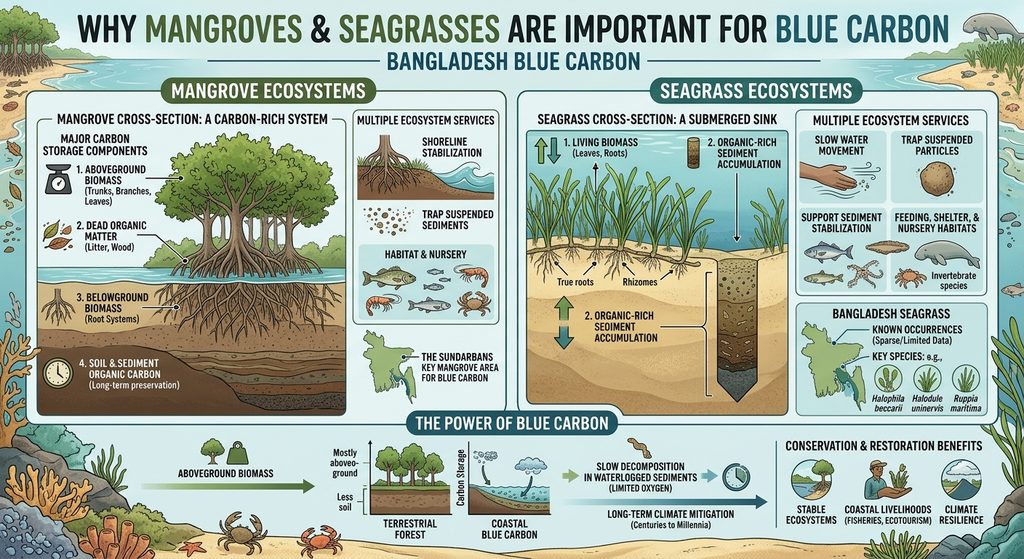
Mangroves and seagrasses are among the most important coastal ecosystems in discussions of nature-based climate mitigation. Unlike many terrestrial ecosystems, they can accumulate substantial quantities of organic carbon in waterlogged sediments, where limited oxygen availability may slow decomposition.
Their importance extends beyond carbon sequestration because they provide multiple ecosystem services that support environmental stability and coastal livelihoods.
Mangrove ecosystems
Mangroves are salt-tolerant woody plants that grow along tropical and subtropical coastlines, estuaries, and tidal environments. Their aboveground biomass, belowground roots, and accumulated sediment organic matter contribute to long-term carbon storage.
In Bangladesh, the Sundarbans provides an important natural setting for investigating mangrove blue carbon.
Major carbon storage components include:
- Aboveground biomass: Carbon stored in trunks, branches, leaves, and other living vegetation.
- Belowground biomass: Carbon accumulated in root systems and associated organic material.
- Soil and sediment organic carbon: Organic carbon deposited and preserved within mangrove sediments over extended periods.
- Dead organic matter: Carbon contained in dead roots, branches, leaves, and decomposing plant material.
Mangrove root systems also trap suspended sediments, reduce wave energy, stabilize shorelines, and create complex habitats for fish, shrimp, crabs, and other aquatic organisms.
Seagrass ecosystems
Seagrasses are submerged flowering plants that grow in shallow coastal and marine waters. They differ from seaweeds because they possess true roots, leaves, and reproductive structures.
Seagrass meadows contribute to blue carbon storage through living biomass and the accumulation of organic-rich sediments. Their leaves can slow water movement, trap suspended particles, and support sediment stabilization.
They also provide feeding, shelter, and nursery habitats for various fish and invertebrate species.
However, the extent of seagrass distribution in Bangladesh remains an important research question. Reliable species identification, field verification, and spatial mapping are necessary before estimating the country’s total seagrass-associated blue carbon stocks.
Assessing mangrove biomass and sediment organic carbon
An important component of blue carbon research is the quantification of carbon stored in mangrove vegetation and underlying sediments. Both aboveground and belowground biomass contribute to ecosystem carbon stocks, while sediment organic carbon represents an important long-term carbon reservoir.
Research on the Bangladesh Sundarbans has demonstrated substantial carbon storage capacity. A 2016 assessment estimated approximately 91.19 teragrams (Tg) of carbon in aboveground and belowground mangrove biomass. A 2026 review reports that total carbon stored in Sundarbans biomass and soils exceeds 100 Tg C, reflecting broader carbon accounting that includes sediment stocks. Springer+1
A species-specific investigation by Ahmed and Kamruzzaman (2021) also demonstrated considerable variation in biomass accumulation and carbon sequestration among major Sundarbans mangrove species. Their research highlighted the influence of tree diameter, stand density, species composition, and climatic variables on carbon accumulation. ScienceDirect
A comprehensive carbon assessment can include the following components:
1. Aboveground biomass estimation
Measuring tree height, diameter at breast height (DBH), species composition, and stand density can help estimate aboveground biomass using appropriate species-specific allometric equations.
2. Belowground biomass assessment
Mangrove root systems contribute substantially to ecosystem carbon storage. Root biomass can be estimated using field measurements or validated root-to-shoot relationships.
3. Sediment organic carbon analysis
Sediment cores collected from different depths can be analyzed to determine organic carbon concentration, bulk density, and sediment carbon stocks.
4. Spatial variation in carbon storage
Carbon accumulation may differ according to salinity gradients, sediment characteristics, vegetation composition, hydrological conditions, and local disturbance.
For example, research in the Bangladesh Sundarbans found higher soil organic carbon stocks in oligohaline areas than in more saline zones, demonstrating the importance of environmental gradients in carbon storage assessment. ScienceDirect
These measurements can help identify carbon-rich mangrove areas that deserve priority in conservation and restoration programmes.
Understanding seagrass distribution and blue carbon potential
Although mangrove carbon storage has received considerable scientific attention in Bangladesh, seagrass ecosystems remain comparatively understudied.
Seagrass meadows can contribute to carbon sequestration through photosynthesis, biomass accumulation, and the retention of organic material within marine sediments. Their ecological importance is also associated with sediment stabilization, water clarity, and the provision of habitats for fish and invertebrates.
Previous investigations have documented seagrass communities along the southeastern coast of Bangladesh, including the occurrence of Halophila beccarii in the Bakkhali Estuary of Cox’s Bazar. Other reported species include Halophila decipiens and Halodule uninervis around Saint Martin’s Island. Academia+1
However, the distribution, total coverage, biomass, and sediment carbon stocks of Bangladesh’s seagrass ecosystems have not been comprehensively quantified. A 2026 review specifically identifies seagrass carbon stocks as an important national research gap. ScienceDirect
A systematic investigation could include:
- Seagrass species identification: Documenting species composition through underwater surveys and specimen identification.
- Distribution mapping: Combining field observations, GPS records, drone imagery, and suitable satellite datasets to identify seagrass-associated areas.
- Seagrass biomass estimation: Measuring shoot density, leaf biomass, belowground biomass, and spatial variation in vegetation coverage.
- Sediment carbon assessment: Collecting sediment cores to determine organic carbon concentration and carbon stocks at different depths.
- Environmental suitability analysis: Examining water depth, turbidity, salinity, substrate composition, and light availability to understand habitat conditions.
The integration of field observations and geospatial technologies could establish a baseline for monitoring seagrass distribution and evaluating its potential contribution to Bangladesh’s blue carbon resources.
Evaluating fisheries nursery habitats and ecosystem services
Beyond their role in carbon sequestration, mangrove and seagrass ecosystems provide important ecological functions that support fisheries sustainability.
Mangrove-associated waterways, tidal creeks, mudflats, and submerged root systems provide feeding, shelter, and nursery environments for different fish and shellfish species. These habitats support juvenile development and provide access to food resources while offering protection from predators.
The Sundarbans supports diverse fish and shellfish communities, including commercially important species of shrimp, mud crab, and finfish. Research has documented the ecological importance of mangrove-associated waters as nursery grounds for aquatic organisms. PubMed Central (PMC)+1
Similarly, a study of saltmarsh and seagrass communities on the southeastern coast of Bangladesh documented 38 fish species and eight shrimp species in adjacent fisheries communities. The study also identified Halophila beccarii as an important nursery habitat for fish. Academia
A fisheries nursery habitat assessment could focus on several ecological indicators:
1. Fish species diversity
Identifying fish species associated with mangrove channels, seagrass beds, and adjacent coastal habitats can provide information about biodiversity and habitat utilization.
2. Juvenile fish abundance
Sampling juvenile fish and recording their abundance, size distribution, and seasonal occurrence can help determine the nursery function of different habitats.
3. Catch per unit effort (CPUE)
Comparing standardized fishing catches across different habitat types can provide insights into fisheries productivity and seasonal variation.
4. Habitat quality assessment
Environmental parameters such as dissolved oxygen, temperature, salinity, turbidity, and sediment characteristics can help explain variations in fish distribution and habitat suitability.
5. Habitat connectivity
Examining the ecological connections between mangroves, seagrass meadows, estuaries, and adjacent coastal waters can help identify important movement pathways for aquatic organisms.
Understanding these relationships is essential because the loss of nursery habitats may affect recruitment, fisheries productivity, and the long-term availability of commercially important aquatic species.
Developing blue carbon conservation and sustainable blue economy strategies
Blue carbon conservation offers an opportunity to connect climate change mitigation, biodiversity protection, coastal management, and sustainable economic development.
For Bangladesh, an integrated management approach could transform mangrove and seagrass conservation into a practical component of coastal adaptation and sustainable blue economy planning.
Several management priorities can be considered:
1. Mangrove conservation and restoration
Protecting existing mangrove forests and restoring degraded areas with ecologically appropriate native species can help maintain carbon stocks, improve coastal protection, and preserve fisheries habitats.
2. Seagrass habitat protection
Identifying and protecting existing seagrass beds should be prioritized through systematic surveys, coastal zoning, pollution reduction, and responsible management of coastal activities.
3. Blue carbon monitoring and accounting
Developing standardized carbon assessment systems can improve national estimates of biomass carbon, sediment organic carbon, and long-term carbon accumulation.
4. Integration with fisheries management
Mangrove and seagrass conservation should be incorporated into fisheries management plans, particularly where these habitats support important breeding, feeding, and nursery grounds.
5. Community-based conservation
Involving local fishers and coastal communities in habitat monitoring, restoration, and sustainable resource management can strengthen conservation outcomes while supporting local livelihoods.
6. Blue carbon financing opportunities
Scientifically verified carbon stock assessments and credible monitoring, reporting, and verification (MRV) systems could help Bangladesh explore blue carbon financing, carbon credit mechanisms, and payment for ecosystem services.
However, carbon credit development requires additional safeguards, including carbon additionality, permanence, leakage assessment, transparent accounting, and protection of community rights.
Why does this research matter?
Bangladesh’s coastal ecosystems are important not only for climate change mitigation but also for fisheries production, biodiversity conservation, coastal protection, and economic development.
Mangrove and seagrass ecosystems provide interconnected environmental services. Their ability to store carbon, stabilize sediments, support aquatic biodiversity, and maintain fisheries habitats makes them valuable natural assets for the country’s long-term environmental sustainability.
However, the lack of comprehensive seagrass distribution maps, standardized carbon inventories, and long-term monitoring data limits the ability to evaluate the full blue carbon potential of Bangladesh.
An integrated research approach could contribute to:
- Identification of important blue carbon storage hotspots.
- Improved estimates of mangrove biomass and sediment organic carbon.
- Mapping and conservation of seagrass ecosystems.
- Protection of important fish breeding and nursery habitats.
- Development of ecosystem-based coastal protection strategies.
- Strengthening climate change mitigation and adaptation planning.
- Exploring sustainable blue economy and carbon financing opportunities.
Most importantly, connecting blue carbon conservation with fisheries management could help ensure that environmental protection also delivers long-term benefits for coastal communities.
Looking ahead
Future research should prioritize the development of a comprehensive blue carbon inventory covering mangrove forests, seagrass meadows, and other relevant coastal vegetated habitats in Bangladesh.
Combining field-based biomass measurements, sediment carbon analysis, satellite remote sensing, GIS-based habitat mapping, and fisheries ecological assessments could provide a more complete understanding of these ecosystems.
Long-term monitoring should also examine how sea-level rise, changing salinity, cyclones, sediment dynamics, pollution, and coastal development influence carbon storage and habitat stability.
Particular attention should be given to the southeastern coastal region, including Cox’s Bazar, the Bakkhali Estuary, and Saint Martin’s Island, where additional investigation of seagrass distribution and associated fisheries resources could address important scientific knowledge gaps.
Furthermore, developing standardized monitoring, reporting, and verification systems could help connect scientific carbon assessments with national climate commitments and potential blue carbon financing initiatives.
The ultimate goal should be to establish an integrated coastal management framework in which carbon conservation, fisheries sustainability, biodiversity protection, and community development are treated as interconnected priorities.
Conclusion
Mangrove and seagrass ecosystems represent valuable natural assets for addressing climate change while supporting coastal ecosystem health and fisheries sustainability in Bangladesh.
The Sundarbans demonstrates the substantial carbon storage potential of mangrove forests, while the country’s relatively understudied seagrass habitats offer important opportunities for future research and conservation.
However, blue carbon conservation should not be limited to estimating the amount of carbon stored in vegetation and sediments. It should also recognize the ecological functions of these habitats, particularly their contributions to fisheries nursery grounds, coastal protection, and the livelihoods of coastal communities.
Integrating carbon stock assessment, habitat mapping, fisheries monitoring, and community-based conservation could provide a scientific foundation for sustainable coastal resource management.
The objective is not simply to store more carbon, but to protect the ecosystems that simultaneously regulate the climate, sustain fisheries, protect coastlines, and support the future of Bangladesh’s blue economy.
Research perspective: This article presents a research-oriented assessment of blue carbon opportunities in Bangladesh. Mangrove carbon estimates are based on published scientific studies, whereas national seagrass carbon stocks and distribution remain insufficiently quantified. Further field validation, sediment analysis, and fisheries habitat assessments are required before developing comprehensive national estimates.
Selected scientific and institutional sources
- Rahman et al. (2016). Blue Carbon Stock of the Bangladesh Sundarban Mangroves: What Could Be the Scenario after a Century? Read research article.
- Ahmed & Kamruzzaman (2021). Species-specific biomass and carbon flux in Sundarbans mangrove forest, Bangladesh. Read research article.
- Rahman et al. (2021). Is soil organic carbon underestimated in the largest mangrove forest ecosystems? Evidence from the Bangladesh Sundarbans. Read research article.
- Abu Hena et al. (2007). Salt marsh and seagrass communities of Bakkhali Estuary, Cox’s Bazar, Bangladesh. Read research article.
- Billah (2016). Saltmarsh and seagrass beds on the south-eastern coast of Bangladesh: Vegetation characteristics and adjacent fisheries diversity. Read research article.
- Purnata et al. (2026). Impact of climate change on natural blue carbon resources of Bangladesh. Read review article.