Aquatic ecosystems in Bangladesh play a vital role in food security, employment, biodiversity conservation, and economic development. Rivers, estuaries, wetlands, lakes, and coastal marine waters support diverse fish populations and provide an important source of animal protein for millions of people. However, increasing industrialization, urbanization, agricultural activities, and inadequate waste management are creating additional pressure on aquatic environmental quality.
Among the major environmental concerns, heavy metal contamination has become an important issue because potentially toxic elements can persist in aquatic environments, accumulate in sediments, and enter aquatic food webs.
Metals such as lead (Pb), cadmium (Cd), chromium (Cr), arsenic (As), mercury (Hg), nickel (Ni), copper (Cu), and zinc (Zn) may enter aquatic ecosystems through industrial effluents, agricultural runoff, municipal wastewater, mining-related activities, and other natural and anthropogenic sources.
Once released into aquatic environments, these metals can be distributed between water, suspended particles, bottom sediments, and aquatic organisms. Certain metals may accumulate in fish tissues through waterborne exposure, sediment-associated pathways, and dietary consumption of contaminated prey.
Consequently, the presence of toxic metals in edible fish raises concerns regarding environmental health, aquatic biodiversity, and human dietary exposure.
In Bangladesh, investigating metal concentrations across water, sediment, and fish tissues is essential for understanding contamination patterns, identifying potential pollution sources, and evaluating the safety of commonly consumed aquatic resources.
Why is heavy metal contamination a major concern?
Heavy metals and metalloids are naturally occurring elements, but their concentrations in aquatic environments can increase due to industrial and other human activities.
Unlike many organic pollutants, metals cannot be biologically degraded into harmless substances. Their environmental mobility, chemical forms, persistence, and biological availability depend on factors such as pH, salinity, redox conditions, sediment composition, and organic matter.
Several metals are particularly important from an environmental and food safety perspective.
- Lead (Pb): May enter aquatic ecosystems through industrial discharge, batteries, urban runoff, and other sources. Chronic exposure can affect neurological and other physiological functions.
- Cadmium (Cd): Associated with industrial waste, fertilizers, and other pollution sources. Long-term exposure can affect kidney function and bone health.
- Chromium (Cr): Different chemical forms have different toxicological properties. Hexavalent chromium [Cr(VI)] is particularly toxic compared with trivalent chromium [Cr(III)].
- Arsenic (As): May originate from natural geological sources as well as anthropogenic activities. Its toxicity depends strongly on chemical speciation.
- Mercury (Hg): Particularly important because inorganic mercury can be transformed into methylmercury, which can bioaccumulate and biomagnify through aquatic food webs.
- Nickel (Ni), Copper (Cu), and Zinc (Zn): Essential trace elements at appropriate concentrations but potentially harmful when environmental or dietary exposure becomes excessive.
The ecological and human health implications of these metals depend on their concentration, chemical form, exposure duration, and bioavailability.
Therefore, assessing contamination requires more than simply detecting metals in water. Sediment and biological samples are also important for understanding environmental accumulation and potential dietary exposure.
What is happening in Bangladesh’s aquatic ecosystems?
Bangladesh has several aquatic environments that experience different levels and sources of pollution pressure.
Industrial zones, densely populated urban areas, agricultural landscapes, and coastal industrial activities can introduce potentially toxic metals into surrounding aquatic systems.
Previous studies have documented metal contamination in several freshwater, estuarine, and marine environments across the country.
For example, a 2024 investigation of the Padma River examined metals in water, surface sediments, and different fish organs. The study reported that measured concentrations in the investigated samples were below the referenced WHO and USEPA limits, with estimated non-carcinogenic health risk indicators generally below the threshold of concern. E-FAS
In contrast, a 2023 study of freshwater, coastal, and marine fishes from southwestern Bangladesh identified elevated concentrations of several metals, including Cr, Pb, As, and Cd in certain fish samples. Its health risk assessment also identified potential concerns associated with dietary exposure. PubMed Central (PMC)
A 2025 investigation of the southeastern coastal region, including the Karnaphuli River, Patenga, and Sandwip, reported toxic metal accumulation in edible fish tissues and identified potential dietary health risks, particularly for children. DOI
Similarly, a 2025 investigation of the Pasur River examined heavy metals in water, sediment, and fish species, demonstrating the relevance of integrated environmental and biological monitoring in riverine ecosystems. DOI
These findings indicate that contamination patterns can vary considerably between aquatic ecosystems, sampling locations, fish species, and environmental conditions. Therefore, national-level conclusions should not be drawn from isolated sampling locations.
Assessing metal accumulation in water, sediment, and edible fish
An important component of this research is the simultaneous investigation of heavy metal concentrations in water, sediment, and edible fish tissues.
These three environmental compartments provide complementary information about contamination pathways and potential ecological and human health risks.
1. Water quality assessment
Water samples can provide information about the concentration of dissolved and suspended metals in aquatic environments.
Important parameters include:
- Lead (Pb), cadmium (Cd), chromium (Cr), and arsenic (As).
- Mercury (Hg), nickel (Ni), copper (Cu), and zinc (Zn).
- pH, temperature, electrical conductivity, and dissolved oxygen.
- Total dissolved solids (TDS) and suspended solids.
Water samples should be collected using appropriate contamination-controlled procedures. Dissolved and total recoverable metal concentrations should be distinguished through suitable filtration and digestion methods.
2. Sediment contamination assessment
Sediments act as important reservoirs for potentially toxic metals because suspended particles and organic matter can accumulate metal contaminants over time.
Sediment analysis can help identify historical contamination and potential secondary pollution sources.
Important assessment parameters include:
- Total metal concentrations in surface sediments.
- Sediment organic matter and total organic carbon.
- Grain size distribution.
- pH and redox conditions.
- Metal enrichment and contamination indices.
Sediment contamination can be evaluated using indices such as the Geo-accumulation Index (Igeo), Contamination Factor (CF), Pollution Load Index (PLI), and Potential Ecological Risk Index (PERI).
However, total sediment metal concentrations do not necessarily represent the biologically available fraction. Additional extraction procedures may be necessary to investigate metal mobility and potential biological exposure.
3. Heavy metal accumulation in edible fish
Fish tissue analysis is particularly important because fish are a major component of the Bangladeshi diet.
Metal concentrations may differ among species depending on feeding habits, habitat preferences, trophic position, age, size, and physiological characteristics.
The investigation can focus on:
- Edible muscle tissue for human dietary exposure assessment.
- Liver and gills for understanding metal accumulation and exposure pathways.
- Differences between herbivorous, omnivorous, and carnivorous species.
- Differences between freshwater, estuarine, and marine fish.
- Spatial and seasonal variations in tissue metal concentrations.
Edible muscle should be the primary tissue for evaluating seafood consumption risks, while other organs can provide additional information about biological accumulation.
Understanding analytical techniques: AAS and ICP-MS
Reliable laboratory analysis is essential for determining metal concentrations in environmental and biological samples.
Two widely used analytical techniques are Atomic Absorption Spectroscopy (AAS) and Inductively Coupled Plasma Mass Spectrometry (ICP-MS).
1. Atomic Absorption Spectroscopy (AAS)
contrAA® 800 D – Analytik Jena GmbH+Co. KG
AAS measures metal concentrations by detecting the absorption of element-specific light by free atoms.
Its applications include:
- Quantification of selected metals in water.
- Analysis of digested sediment samples.
- Determination of metal concentrations in fish tissues.
- Environmental contamination monitoring.
Different AAS configurations, including Flame AAS and Graphite Furnace AAS, provide different analytical sensitivity and detection capabilities.
2. Inductively Coupled Plasma Mass Spectrometry (ICP-MS)
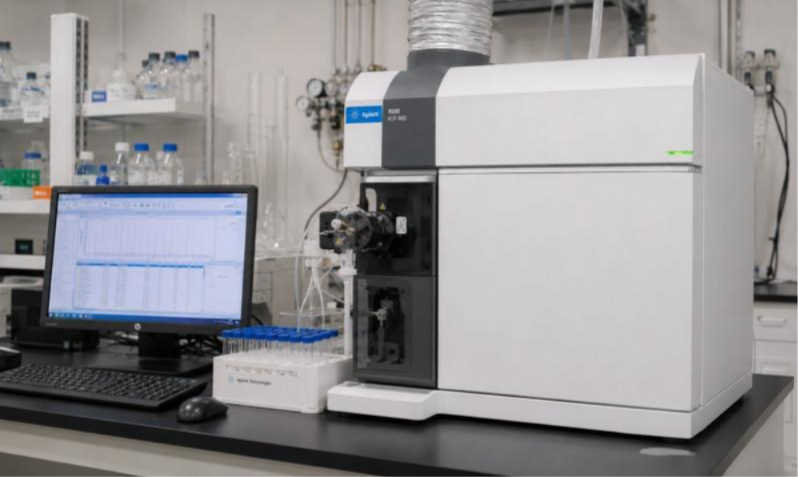
ICP-MS is a highly sensitive analytical technique that can detect multiple elements at very low concentrations.
Its major applications include:
- Multi-element analysis of aquatic environmental samples.
- Trace metal determination in fish tissues.
- Identification of low-level contamination.
- Comparison of metal distribution across different environmental compartments.
ICP-MS is particularly useful when investigating multiple metals simultaneously, although it requires careful sample preparation, calibration, and interference control.
3. Quality assurance and quality control (QA/QC)
Reliable results require appropriate laboratory quality control, including:
- Reagent and procedural blanks.
- Certified reference materials (CRMs).
- Calibration standards.
- Duplicate sample analysis.
- Spike recovery tests.
- Detection and quantification limits.
Metal concentrations should be reported with clearly specified units and wet-weight or dry-weight basis. This is particularly important when comparing fish tissue results with food safety standards.
Evaluating bioaccumulation, contamination levels, and dietary exposure
The identification of metal concentrations alone is insufficient to determine the environmental and public health significance of contamination.
An integrated assessment should investigate the relationships between environmental contamination, biological accumulation, and human dietary exposure.
1. Bioaccumulation assessment
Bioaccumulation refers to the accumulation of substances in an organism from different exposure pathways over time.
Bioaccumulation factors (BAF) and biota-sediment accumulation factors (BSAF), where appropriate, can help investigate relationships between environmental metal concentrations and fish tissue accumulation.
Species-specific differences can provide insights into the influence of feeding behaviour, habitat utilization, and exposure pathways.
2. Metal contamination indices
Several assessment tools can be applied to evaluate environmental contamination:
- Contamination Factor (CF).
- Geo-accumulation Index (Igeo).
- Pollution Load Index (PLI).
- Metal Pollution Index (MPI).
- Potential Ecological Risk Index (PERI).
These indices can help compare contamination levels between sampling locations and identify areas requiring further investigation.
3. Estimated Daily Intake (EDI)
EDI estimates the amount of a particular metal consumed through fish intake relative to body weight.
It considers fish tissue concentration, daily consumption rate, and consumer body weight.
This indicator can help compare dietary exposure among adults and children.
4. Target Hazard Quotient (THQ) and Hazard Index (HI)
THQ is used to evaluate potential non-carcinogenic health risks associated with long-term exposure to individual contaminants.
The Hazard Index combines the relevant hazard quotients to assess potential cumulative non-carcinogenic exposure.
Generally, THQ or HI values below 1 indicate that non-carcinogenic effects are unlikely under the assumptions of the assessment. Values above 1 indicate potential concern requiring further evaluation, not proof of disease.
5. Target Cancer Risk (TCR)
For contaminants with established carcinogenic toxicity values and appropriate exposure models, cancer risk assessment can provide an estimate of potential lifetime cancer risk.
Arsenic, cadmium, and certain chromium compounds require particular attention. Total chromium should not automatically be treated as hexavalent chromium; chemical speciation is important for appropriate risk characterization.
Developing an integrated aquatic pollution management approach
Heavy metal contamination requires coordinated environmental monitoring, pollution prevention, seafood safety assessment, and institutional management.
Based on the potential environmental and public health concerns, several practical strategies can be considered.
1. Industrial pollution control
Strengthening industrial wastewater treatment, monitoring effluent discharge, and ensuring compliance with environmental standards can reduce metal inputs into rivers, wetlands, and coastal waters.
2. Regular aquatic environmental monitoring
Establishing periodic monitoring programmes for water, sediment, and fish tissues can help identify contamination hotspots and detect changes in pollution levels.
3. Seafood safety surveillance
Regular testing of commercially important fish species can help identify potentially contaminated products and support evidence-based seafood safety decisions.
4. Pollution source identification
Multivariate statistical techniques, including Principal Component Analysis (PCA), Hierarchical Cluster Analysis (HCA), and correlation analysis, can help investigate possible relationships between contamination patterns and potential pollution sources.
These techniques support source interpretation but do not independently prove the origin of contaminants.
5. Risk-based fisheries management
Where contamination is confirmed, appropriate management measures may include targeted monitoring, pollution-source reduction, public health communication, and location-specific fish consumption advisories based on validated risk assessments.
6. Community awareness and institutional coordination
Fishers, fish traders, consumers, researchers, fisheries authorities, and environmental agencies should be involved in strengthening aquatic pollution surveillance and food safety awareness.
A coordinated approach can connect environmental protection with consumer safety and sustainable fisheries management.
Why does this research matter?
Fisheries and aquaculture are important contributors to Bangladesh’s food security, employment, and national economy. However, aquatic pollution can create challenges that extend beyond ecosystem degradation and directly affect seafood quality and consumer safety.
Heavy metal contamination is particularly important because contaminated fish can act as a pathway of human exposure, especially among communities that regularly consume locally harvested aquatic products.
An integrated research approach can help connect environmental contamination with biological accumulation and dietary exposure.
The findings could contribute to:
- Identification of heavy metal contamination hotspots.
- Assessment of pollution levels in freshwater, estuarine, and marine ecosystems.
- Improved understanding of metal accumulation in commercially important fish.
- Identification of potential industrial and agricultural pollution sources.
- Evaluation of dietary exposure among adults and children.
- Strengthening seafood safety monitoring and quality assurance.
- Development of evidence-based aquatic pollution management strategies.
Most importantly, combining environmental chemistry with fisheries science can help establish a stronger scientific foundation for protecting aquatic ecosystems and maintaining consumer confidence in Bangladesh’s fisheries products.
Looking ahead
Future research should prioritize the development of long-term heavy metal monitoring programmes covering selected rivers, estuaries, wetlands, lakes, and coastal marine ecosystems of Bangladesh.
The integration of AAS or ICP-MS laboratory analysis with GIS-based spatial assessment could help identify contamination hotspots and investigate differences between freshwater, estuarine, and marine environments.
Particular attention should be given to industrially influenced aquatic systems, including the Karnaphuli River, Buriganga River, Turag River, Pasur River, and selected coastal ecosystems.
Further investigations should also examine seasonal variations in metal concentrations, sediment-associated metal mobility, species-specific bioaccumulation, and differences in dietary exposure among consumer groups.
In addition, integrating metal speciation, stable isotope analysis, and advanced statistical modelling could provide deeper insights into contamination pathways and trophic transfer mechanisms.
Ultimately, a coordinated monitoring framework connecting environmental laboratories, fisheries research institutions, food safety authorities, and local communities could help improve aquatic pollution management and protect seafood quality.
Conclusion
Heavy metal contamination in aquatic environments represents an important environmental and food safety concern for Bangladesh. The presence of potentially toxic metals in water and sediments can influence aquatic organisms, while their accumulation in edible fish tissues may create additional risks through human dietary exposure.
An integrated assessment of water, sediment, and fish samples using AAS or ICP-MS can provide valuable information about contamination levels, spatial distribution, accumulation patterns, and potential pollution sources.
Combining laboratory analysis with contamination indices, bioaccumulation assessment, and dietary health risk evaluation can transform environmental monitoring results into practical information for pollution control and seafood safety management.
The objective is not simply to identify toxic metals in aquatic environments, but to understand how they move through aquatic ecosystems, accumulate in edible fish, and potentially reach human consumers—ultimately supporting safer seafood, healthier aquatic ecosystems, and sustainable fisheries in Bangladesh.
Research perspective: This article presents a research-oriented assessment framework based on published studies and established analytical approaches. Contamination levels and health risks must be established through location-specific sampling, laboratory validation, appropriate food safety standards, and scientifically justified exposure assessments. No new experimental results are claimed.
References:
- Impact of anthropogenic activities on the accumulation of heavy metals in water, sediments and some commercially important fish of the Padma River, Bangladesh (2024). Read research article.
- Assessment of human health hazard associated with heavy metal accumulation in popular freshwater, coastal and marine fishes from south-west region, Bangladesh (2023). Heliyon. Read research article.
- Toxic metal Accumulation in Edible Fishes and Associated Human Health Risks: Evidence from Southeastern Coastal Region of Bangladesh (2025). Journal of Food Protection. Read research article.
- Occurrence of heavy metals in fish species, water and sediments of the Pasur River in Bangladesh along with assessments of ecological and human health risks (2025). Read research article.
- Metals Bioaccumulation in 15 Commonly Consumed Fishes from the Lower Meghna River and Adjacent Areas of Bangladesh and Associated Human Health Hazards (2022). Read research article.
- Occurrence of trace elements in water, fish and shellfish from estuarine and coastal areas of the east coast of Bangladesh, northeast Bay of Bengal: Human health risk implications (2025). Read research article.