Understanding the risks, examining the evidence, and exploring preventive management strategies for a potentially invasive freshwater fish
Recent media reports concerning the occurrence of alligator gar (Atractosteus spatula) in natural waterbodies in Bangladesh have drawn attention to a potentially emerging issue for the country’s aquatic ecosystems. The reports have raised important questions about the introduction, distribution, and possible ecological consequences of this large predatory fish.
In response to these developments, researchers at the Centre for Coastal Research and Sustainability (CCRS) are currently investigating the potential invasion risk of alligator gar in Bangladesh. The ongoing study aims to assess the species’ biological and ecological characteristics, examine its possible introduction pathways, evaluate its potential to establish and spread under local environmental conditions, and explore appropriate management strategies.
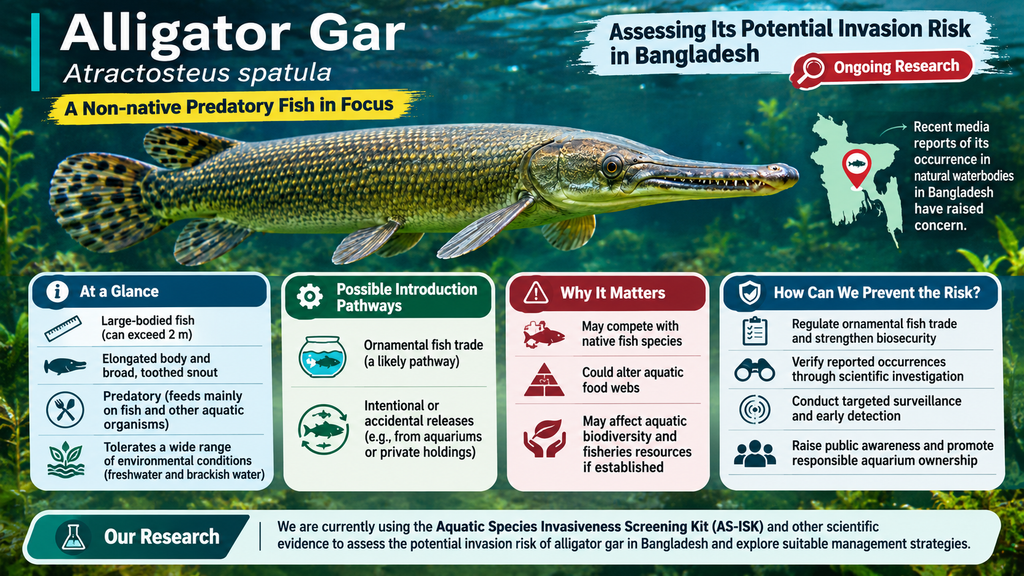
Why is Alligator Gar attracting attention?
Alligator gar is a large-bodied freshwater and brackish-water fish native to North America. It is recognized by its elongated body, broad snout, prominent teeth, and ability to tolerate a range of environmental conditions. As a predominantly piscivorous predator, it feeds on fish and other aquatic organisms.
Several characteristics make this species important from an invasion-risk perspective. These include its predatory feeding behaviour, environmental tolerance, relatively large body size, and reproductive biology. If introduced into suitable habitats beyond its native range, these characteristics may contribute to its establishment and potential interactions with native aquatic communities.
However, the ecological consequences of its introduction depend on several factors, including habitat suitability, prey availability, population density, reproductive success, and interactions with native species. Therefore, its potential impacts in Bangladesh require scientific investigation rather than assumption.
What do recent reports mean for Bangladesh?
Media reports and anecdotal accounts of alligator gar in Bangladesh have highlighted the need for systematic investigation. Reported observations from different locations provide a reason to examine whether the species has entered local aquatic environments.
Nevertheless, reported sightings or isolated captures do not necessarily indicate the establishment of a self-sustaining population. Scientifically confirming its status requires reliable specimen identification, georeferenced occurrence records, and further investigation into whether the species is reproducing and persisting in natural waterbodies.
At present, there is no conclusive evidence establishing self-sustaining populations of alligator gar in Bangladesh. Similarly, its effects on native fish populations, aquatic food webs, fisheries production, and ecosystem functioning have not yet been empirically demonstrated under local conditions.
Distinguishing between reported occurrence, confirmed establishment, and demonstrated ecological impact is therefore a central consideration of this research.
Assessing invasion risk using AS-ISK
An important component of the ongoing study is the application of the Aquatic Species Invasiveness Screening Kit (AS-ISK), a risk-screening framework developed to evaluate the potential invasiveness of aquatic species.
The assessment considers two major components:
- Basic Risk Assessment (BRA): Evaluates the species’ biogeographical, historical, biological, and ecological characteristics associated with its potential to establish and spread.
- Climate Change Assessment (CCA): Examines how projected climate-related changes may influence the species’ potential invasion risk.
The preliminary assessment of alligator gar in Bangladesh produced the following scores:
| Assessment component | Preliminary score |
|---|---|
| Basic Risk Assessment (BRA) | 16 |
| Climate Change Assessment (CCA) | +4 |
| Combined AS-ISK score | 20 |
These preliminary results indicate a prospective invasion risk that warrants further attention and precautionary consideration. Importantly, the AS-ISK score is a risk-screening outcome, not evidence that the species has already established in Bangladesh or caused ecological damage. The assessment is being interpreted alongside the available evidence and the limitations of current Bangladesh-specific occurrence information.
Potential introduction pathways and environmental suitability
The ornamental fish trade and subsequent intentional or accidental releases are recognized as plausible pathways through which alligator gar may be introduced beyond its native range. However, the specific pathway responsible for the reported occurrences in Bangladesh has not yet been verified.
Bangladesh’s extensive river networks, floodplains, wetlands, haors, and beels create a complex aquatic landscape. Seasonal flooding and hydrological connectivity may facilitate the movement of aquatic organisms between waterbodies. These characteristics make habitat connectivity an important consideration when evaluating the potential establishment and dispersal of non-native fish species.
The ongoing research is examining these factors alongside the species’ environmental tolerance and biological characteristics to understand where potential risks may be greatest.
Developing a preventive and stage-based management approach
Risk assessment alone is not sufficient to address the potential introduction of an invasive species. Effective management requires actions that correspond to the available evidence and the stage of invasion.
Based on the ongoing assessment, the study is developing a context-specific, stage-based management framework for alligator gar in Bangladesh. Its major components include:
1. Prevention and biosecurity
Strengthening ornamental fish trade regulation, improving import and movement controls, and promoting responsible aquarium ownership to reduce the possibility of further introductions.
2. Verification of reported occurrences
Investigating reported locations through field observations, photographic documentation, reliable specimen identification, georeferenced records, and molecular confirmation where appropriate.
3. Early detection and surveillance
Developing targeted monitoring approaches involving field surveys, fishers’ observations, market inspections, and other relevant surveillance activities. Environmental DNA (eDNA) may offer an additional detection approach, provided that species-specific assays are properly developed and validated.
4. Containment and rapid response
Where the presence of alligator gar is confirmed, assessing its distribution, nearby habitats, and hydrological connectivity to determine appropriate containment and response measures.
5. Conditional eradication or population suppression
Localized eradication may be considered where confirmed populations are restricted to isolated waterbodies and removal is technically feasible. In contrast, population suppression and containment may be more appropriate if established populations become widespread in connected riverine or wetland systems.
6. Long-term monitoring and adaptive management
Monitoring distribution, population status, ecological interactions, and potential effects on native aquatic communities to support future management decisions.
The framework emphasizes that eradication and suppression are conditional interventions, not immediate recommendations for Bangladesh. Their implementation would depend on confirmed occurrence, establishment status, waterbody characteristics, technical feasibility, and appropriate environmental safeguards.
Why does this research matter?
Bangladesh is highly dependent on its aquatic resources for food security, livelihoods, employment, and ecological sustainability. Its freshwater ecosystems support diverse native fish communities and provide essential services to millions of people.
The introduction of non-native aquatic species can create additional ecological and management challenges, particularly when early detection and response mechanisms are limited. Investigating potential invasion risks before a species becomes established offers an opportunity to strengthen preparedness and reduce the likelihood of future ecological and economic consequences.
This research also highlights the importance of connecting scientific risk assessment with practical management planning, institutional coordination, and public awareness.
Looking ahead
The study is ongoing, and several important questions remain to be addressed. These include the verification of reported occurrences, identification of possible introduction pathways, assessment of the species’ actual distribution, and investigation of its establishment and reproductive status in Bangladesh.
Further field-based research and systematic surveillance will be essential to determine whether alligator gar is present in natural waterbodies and whether it poses a measurable threat to local aquatic ecosystems.
At CCRS, we believe that emerging environmental concerns should be addressed through reliable evidence, scientific assessment, and proactive collaboration. Our ongoing work aims to contribute to a stronger scientific foundation for aquatic invasive species surveillance and management in Bangladesh.
The objective is not to create unnecessary alarm, but to understand potential risks early, strengthen preventive measures, and support informed decisions to protect the country’s aquatic biodiversity and fisheries resources.
Research status: Ongoing. The AS-ISK scores presented here are preliminary research assessment results and should not be interpreted as confirmation of species establishment or demonstrated ecological impacts in Bangladesh.